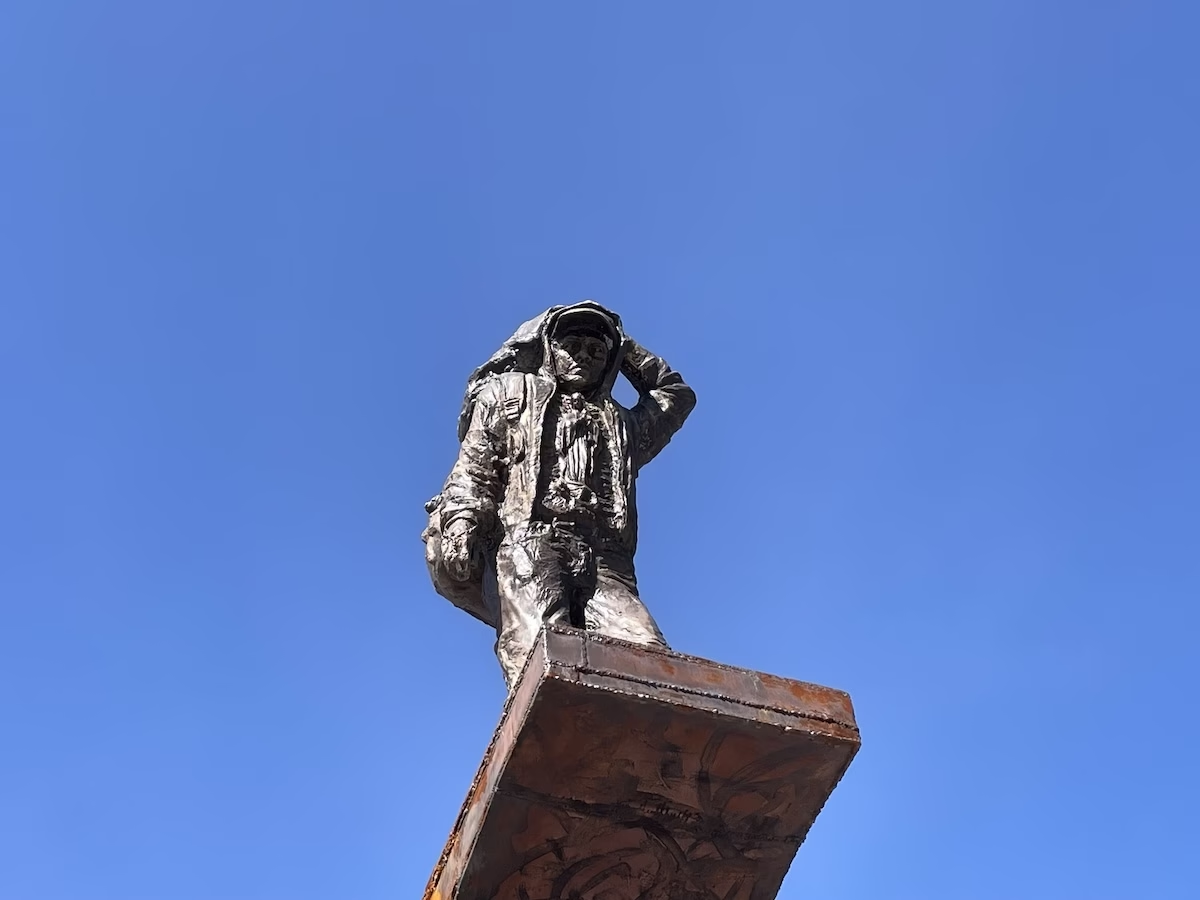
This winter, Immigration and Customs Enforcement officers invaded my home city of Minneapolis in one of the largest ever immigration raids in United States history. Two people were killed and thousands of others abducted from their homes, cars, schools and work places. Maybe you read about it.
I’ve always been pro-immigration. I’m the grandchild of immigrants myself, so how could I not be? The recent immigration crackdown in my city, though, has led me to start thinking a lot more about this issue. I’ve also been thinking of how it relates to tourism, especially in the context of my recent trip through Latin America.
On our journey from Guatemala to Argentina, we constantly met people with family in the United States. We also met a few people making the long journey north. I learned a lot from these people, and now I want to share that with you. Hence this post about what traveling in Latin America taught me about immigration.
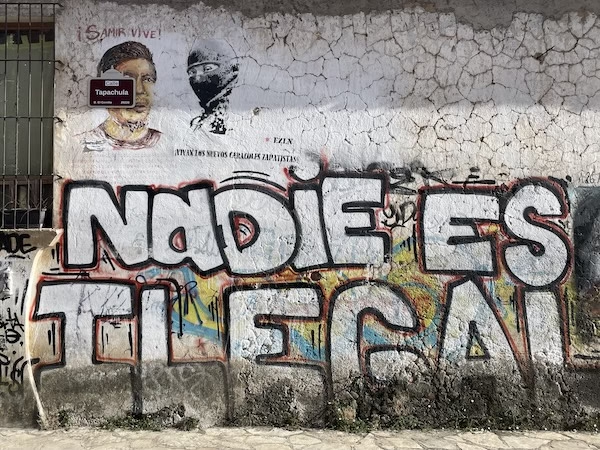
The International Immigration System is Fundamentally Unfair
The first thing I want to share is how absolutely unfair and uneven our immigration system is. Those of us from the United States or Europe can pretty much travel wherever we want with few restrictions. Most countries don’t require visas in advance. El Salvador didn’t even look at our passports. This freedom doesn’t work both ways.
We met a couple in Guatemala whose dream was to visit the U.S. and see the sights, like the Grand Canyon and the Statue of Liberty. They were a middle-class couple with no desire to immigrate, they just wanted to travel as tourists. They had to wait five years to get a tourist visa.
A woman I met in Nicaragua just wanted to go and visit her husband who was working in neighboring Costa Rica. She had to get up at three in the morning to catch the bus to Managua in order to complete her paperwork at the Costa Rican embassy. Her application was denied.
And yet, as a U.S. citizen, I am able to hop borders whenever I want for any reason that pops in my head. The worse that’ll happen is I have to wait in line for a while, or somehow produce proof of an onward ticket. I love this freedom, but I also recognize that it is fundamentally unfair that other people don’t have the same freedom just because they happen to be born on the wrong side of the Rio Grande.
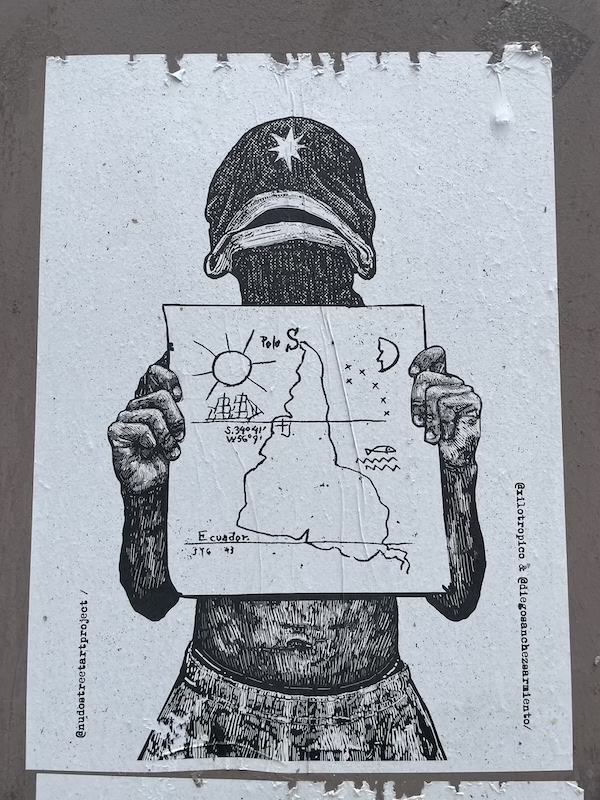
People From Other Countries Love America Way More than Most Americans
A lot of Americans have this impression that most of the world hates us. Our media paints a picture of a hostile planet full of people who hate us for our freedom. Or else their just French. In my experience, though, the reality is quite the opposite.
People all around the world absolutely love the U.S. If I had a dime for every time someone’s eyes lit up when I told them I was from the United States, I’d be rich enough to quit my job and travel full time. They love our movies, they love our music, they love our culture, and they love us.
I’ve experienced this in Latin America and even in China. Yes, that China. In fact, I probably found more pro-American sentiment in China than anywhere else, including the U.S.
Even people who disagree with the U.S. government are still very friendly and open to us as people. A Nicaraguan museum guide, after talking about the Sandinista struggle against the U.S. backed dictatorship and imperialism, made a point to take us aside and say “when I say imperialism, I don’t mean the U.S. people.” I’ve heard similar sentiments elsewhere.
Most Americans, on both sides of the aisle, have grown quite cynical about our country. In fact, we don’t seem to like each other very much at all. The rest of the world still believes in the American Dream. They view our country as the land of opportunity where you can get rich with just a little hard work and old-fashioned gumption. I can never muster the heart to burst their bubble and tell them the American Dream died sometime between 9/11 and the 2008 recession.
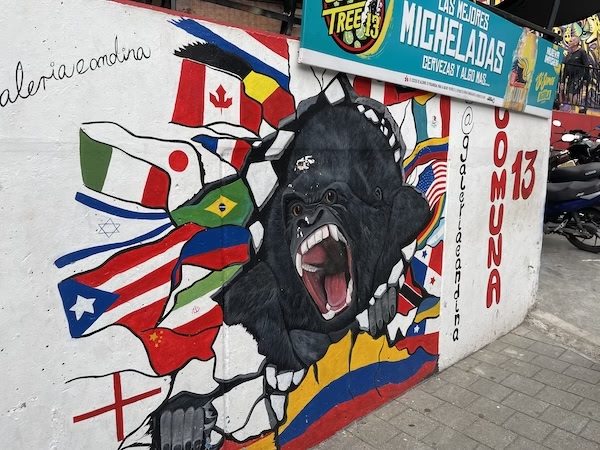
Immigrants Go Through Hell to Come to the U.S.
As I just said, people love the United States. They love it so much that they’re willing to go through hell to get here. Almost literal hell.
We saw migrant families living on the streets, getting by mostly on charity. In Costa Rica, we saw Venezuelan women working as prostitutes in order to make money to journey to the U.S. We met a Colombian man who crossed the notorious Darien Gap, a no-man’s land between Panama and Colombia full of swamps, disease, gangs, paramilitaries and dangerous jungle animals. He told us about seeing a flash flood rip a child from its mother’s arms and a man eaten by a jaguar.
That’s to say nothing of the cartels that prey on migrants, or the people who make their way through the inhospitable desert wilderness of New Mexico and Arizona.
Now, I can say from experience that living in a different country is quite difficult. And my experience was absolutely nothing compared to what these people go through. Nothing.
I can’t even contemplate the risk and bravery involved in trying to make it to the United States. I can also say that everyone who comes here must have a very good reason. Nobody risks getting eaten by jaguars without a good reason.
U.S. Policies are What Cause People to Immigrate in the First Place
The love people have for the United States, and the horrendous, dangerous journey they make to get here, feels extra tragic when you think about the bigger geo-political reasons driving people to migrate.
As I said, nobody leaves their home to trek through dangerous jungle with only a backpack and a prayer without a good reason. People are escaping extreme poverty, violence and corruption. And unfortunately, a lot of that is caused directly or indirectly by the U.S. government.
The United States has a long, terrible, history of treating Latin America like its own personal colonial playground. Our tax dollars have gone to overthrow democratically elected governments throughout the region, supporting dictatorships, funding paramilitary groups and illegal weapons deals. And that’s just the stuff that’s easy to Google.
In the last year, Donald Trump has kidnapped the president of Venezuela and is now threatening Cuba.
All of this has led to, and is leading to, instability and chaos in the region. This instability and chaos are what cause people to migrate in the first place.
This Anti-Immigrant Bullshit Didn’t Start with Trump
I would love to blame the orange asshole in the Whitehouse for all the horrible, racist bullshit immigrants have to deal with. Unfortunately, the ruling class in the United States has been using immigrants as scapegoats for decades.
One hundred years ago, my people, the Italians, bore the wrath of anti-immigrant hatred. You could almost find some of that anti-Italian propaganda and replace the words “Italian” with “Venezuelan” and you’d have a modern Trump speech.
And of course, let’s not forget about the Irish. Or the Jews. Or the Chinese. Or the Japanese. This sad list goes on and on.
I can’t believe that Americans are inherently racist or anti-foreigner. If you look at this country’s history, the anti-immigrant noise seems to get louder when you have a greater concentration of wealth and a greater division between rich and poor. Immigrants are paid less and competition keeps wages low. They were brought in as strike breakers when native born workers got too uppity, and used as scapegoats for society’s ills. The rich blame immigrants to distract us while they rob us blind.
Sadly, you can see this happening in other countries, too. We heard anti-immigrant sentiment in Ecuador and Peru. Chile recently elected the son of a Nazi who ran on a hardline anti-immigrant platform.

Immigrants Make America Great
One thing I didn’t realize about the United States until I returned to the United States is how special the United States is. Not in an overly patriotic big truck cowboy hat handgun sort of way, but a way that pisses off the big truck handgun crowd. The real amazing thing about the United States is our diversity.
I live in the city of Minneapolis. Minneapolis is a relatively small city. The entire metropolitan area has a population of about 4 million. That sometimes sounds like a lot, but it’s nothing compared with cities like Mexico City or Bogotá. And it would be basically a tiny village in China.
Yet, this city is incredibly diverse. And not just diverse in the sense that there are non-white people. I regularly hear multiple languages spoken on the bus. I can walk down the street and meet people from four different continents. I can easily get delicious and reasonably authentic food from Vietnam, Somalia, Ethiopia, Ecuador, El Salvador and places beyond. And Minneapolis actually has a relatively low immigrant population compared to other U.S. cities.
No other country I’ve been to has this much cosmopolitan internationalism. Sure, you can find different types of food in bigger cities like Mexico City or Bogotá (or Shanghai), but there’s still nowhere near the variety you find in Minneapolis. And you don’t really see different ethnic neighborhoods in other countries like you do in Minneapolis or elsewhere in the U.S. Everywhere you go still feels very Mexican, or Colombian (or Chinese). And when you get to smaller cities, almost any sense of internationalism completely disappears.
The degree to which Americans have access to food and culture from all around the world is kind of mind-blowing. It’s an amazing thing that (as far as I’ve seen) is pretty uniquely American.
Conclusion: An Attempt to Sum Up What Traveling in Latin America Taught Me About Immigration
Sadly, like drinkable tap water and relatively higher wages, we Americans tend to take our diversity for granted. U.S. billionaires are hoarding wealth, flying in private jets to pedophile islands and basically robbing us blind while they point the finger at the immigrants who just came to try and make a better life for themselves and their families.
I’m proud of my city and state for standing up to Trump and the goons in ICE. But unfortunately, we still have a long way to go before we start treating immigrants with the respect and dignity they deserve.
I am very lucky that I’ve had the opportunity to travel as much as I have. Especially in Latin America, I’ve found the people in the countries I’ve visited to be incredibly warm and welcoming. One of the greatest joys of traveling or living abroad is meeting and interacting with the local people who are kind enough to let us into their home countries. The very least we can do is return the favor when people from those countries come to ours.