When we told our friends and family that we were planning a six-month backpacking trip through Central America, most of them thought we were crazy. They swore we were going to get murdered by the cartels, or worse. In the U.S. media, and in some people’s minds, the region has become synonymous with crime and gangs. Were we crazy? Is Central America safe for tourists?
Obviously, I don’t want to undercut the very real security issues Central Americans face on a daily basis. The region’s homicide rate is three times the global average, and half of those homicides are connected to organized crime. It is definitely a place where bad stuff can and does happen.
However, the reality is that most of this crime is very concentrated. 50% of all crimes occur in only 2.5% of street space. And when you narrow it down to homicide, you get a whopping 80% of murders in Latin America occurring on only 2% of streets.
Crime, especially homicide, in Central America mainly affects locals. An ex-Guatemalan gangster once told me that tourists are essentially invisible to the gangs. But you don’t have to take his word for it. I looked up the data and found that the chances of U.S. citizens being murdered in Central America are incredibly small.
Central America is, in fact, very safe for tourists.
What Does the Data Say About Central American Travel Safety?
The United States State Department keeps a record of all citizens who die overseas. You can look it up, and it’s actually quite fascinating. The data includes the country and cause of death. Unfortunately, they only have data from 2023 available.
But we can work with that. I looked over the deaths of U.S. citizens in Belize, Costa Rica, Guatemala, El Salvador, Honduras, Nicaragua and Panama. I found that the vast majority died by drowning. Second was vehicular accidents, and then the vague “other accident.” In all of 2023, there were only five U.S. citizens who died of homicide in Central America.
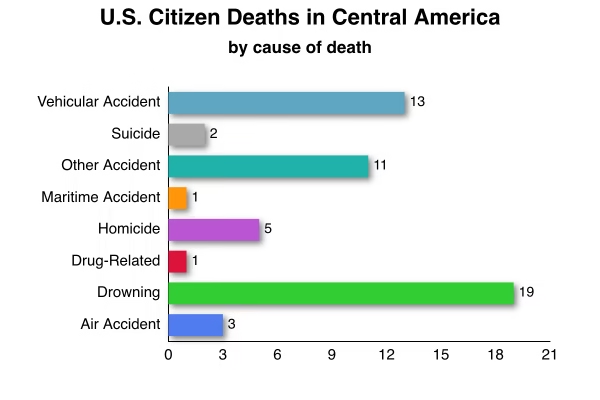
Yes, five.
That number is low, but it feels exceptionally low when you consider there were a whopping 4,314,049 U.S. tourists in Central America in 2023. And that’s not counting Nicaragua, which doesn’t keep a record of visitor nationalities.
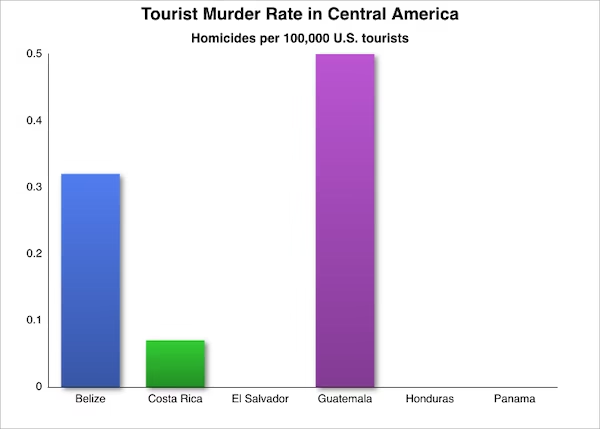
The homicide rate, as well as number of visitors, vary by country. Guatemala had the highest number of murders with two. That’s out of 394,258 U.S. visitors. El Salvador, Honduras and Panama had zero murders, while Costa Rica, Nicaragua and Belize each had one.
Still, five homicides in Central America out of over four million tourists. That gives Central America a murder rate of about .12 out of 100,000. Compare that to 4.1 out of 100,000 for New York City.
In other words, the average U.S. tourist has a 1 in 862,810 chance of being murdered in Central America. By comparison, one estimate puts the lifetime odds of being killed by a meteorite as 1 in 700,000.
Of Course, the Numbers Don’t Tell the Whole Story
The U.S. State Department data does have some limitations. The obvious one, which you’ve probably figured out, is that it only deals with travelers from the United States. In general, though, U.S. citizens make up the bulk of visitors to Central America. I doubt that Brits or Australians are getting murdered at a significantly higher rate.
Another big problem is that we don’t know the circumstances of these homicides. Was a tourist in the wrong place at the wrong time? Was it a gang member from the U.S. who got caught up in a botched drug deal? Or maybe a crime of passion? There’s absolutely no way to tell from the numbers.
We also have the possibility that the data is wrong or otherwise misleading. The third largest cause of death amongst U.S. tourists was listed as “other accident.” What the hell does that mean? It’s possible that a country with a corrupt, authoritarian government trying to boost its image on the international travel scene would list a homicide as an “other accident.” Or maybe someone just slipped and fell. There’s no way to know.
Despite those caveats, I still think the data makes one thing exceedingly clear. The chances of being murdered as a tourist in Central America are tiny.
Other Dangers of Traveling in Central America
While your chances of being murdered are slim, you do have a slightly higher chance of dying in other ways while traveling in Central America.
Drowning: Drowning is the big one. While your chances are still small, drownings made up the majority of deaths of U.S. citizens in 2023. The oceans and lakes of Central America are beautiful, but they can be deadly.
Always make sure to wear a life jacket when you’re on a boat. I know it looks dorky, but I’ve had storms and big waves sneak up on me. I was glad to have a lifejacket then, let me tell you.
You should also watch out for rip tides when swimming or surfing in the ocean. Rip currents are dangerous, and can easily turn deadly. You can find some more information on recognizing and surviving a rip tide here.
Car crashes: The second largest cause of death is vehicular accidents. Drivers in Central America can be absolutely crazy. Roads are often narrow and winding or in poor condition. And many cars and buses don’t have functioning seat belts.
There’s not much you can do about the danger of traffic accidents, unfortunately. If you’re in a cab, you can ask the driver to slow down if you feel he’s driving unsafely. You can try and find vehicles with seat belts. Most of the time, though, you’re in the hands of fate.
You can, however, be sure to look both ways when crossing the street. Pedestrians in this region definitely do not have the right of way. Keeping your wits about you in traffic will go a long way in helping you stay safe traveling in Central America.
Remember, though, out of over four million U.S. tourists, there were only fifty-five total deaths in Central America in 2023.
What are the Safest Countries in Central America?
You might be wondering what is the safest Central American country for tourists?
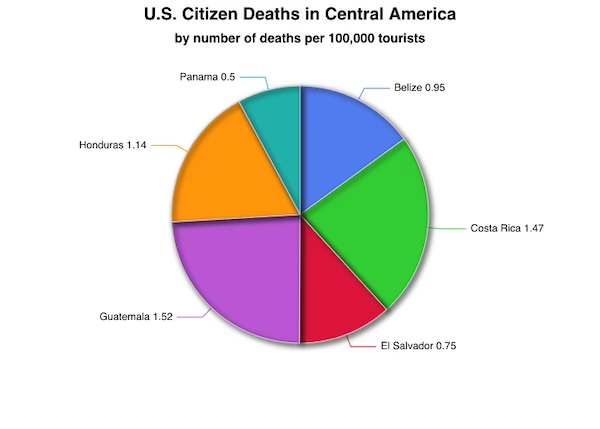
Conventional wisdom would tell you that Costa Rica is safest. In fact, twenty-one U.S. citizens died in Costa Rica in 2023. Considering how popular the country is with travelers, that leaves us with a death rate of 1.47 per 100,000 U.S. tourists. By those calculations, Costa Rica is actually the second most dangerous country in Central America.
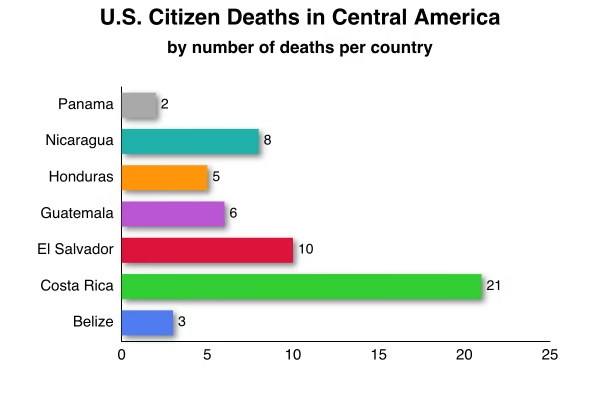
The most dangerous, in fact, is Guatemala. Guatemala also had the most homicides, with a whopping total of two. That’s out of six deaths total. However, considering that far fewer tourists visit Guatemala than Costa Rica, we get a death rate of 1.52 per 100,000 tourists. That’s the total death rate, not the homicide rate.
Honduras, Belize and El Salvador round out the rest of the list for highest U.S. citizen deaths. Again, considering how many tourists visit these countries, the chances are still quite small. And just a reminder: I’m leaving out Nicaragua due to lack of data about total U.S. visitors. Luckily, only eight Americans died there in 2023.
That leaves us with Panama, which is officially the safest country in Central America. At least, according to the U.S. State Department’s data. Panama had a death rate of only .5 per 100,000 tourists. In 2023, only two U.S. citizens died in Panama. One drowned, and one got in a car accident.
The chances of tourists being killed anywhere in Central America are tiny. But, if you were interested, those chances are the tiniest in Panama. We ought to give Panama an award for safest country in Central America. Maybe a nice trophy or a sash.
How to Stay Safe Traveling in Central America
Even though your chances of being killed in Central America are small, there are still some things you can do to make those chances even smaller. Most of the following safety advice is common sense, standard big-city situational awareness.
I should say, though, that I am a man. I recognize that I have a very different perception of safety than women. If you’re a woman traveling solo, you don’t need to be afraid, but you do have some specific issues I’m simply not qualified to do justice to. Because of that, I’m going to suggest this post that’s geared specifically towards female travelers: https://www.adventurouskate.com/solo-female-travel-central-america-safe/
However, there are some general bits of advice I can share.
Learn Spanish: My number one bit of advice for staying safe in Central America is to learn some Spanish. We had a number of times when locals warned us that we were about to wander into a sketchy street. A few times they even walked us back to a safe area. All of these interactions were in Spanish.
If your Spanish is limited, you can still ask for advice about safe parts of town from your accommodation. Most people working in hotels and hostels will be happy to give you advice. Taxi drivers are another great resource (if you’re able to communicate with them.)
Avoid isolated areas: Most parts of Central America are safe during the day, but stick to well-lit areas with lots of people when walking at night. As a general rule of thumb, if you see children and old people, you’re fine. Be especially careful on remote hiking trails, and never hike alone.
If you do get mugged, just give them what they want. Your money and cell phone aren’t worth nearly as much as your life.
Don’t Go Looking for Trouble
The other important safety rule is to avoid drugs and prostitution. I know everyone reading this blog is an upstanding person who would never engage in sex tourism. You might, however, be tempted to want to get a little high on your vacation. Don’t.
Remember when I said tourists were invisible to the gangs? Well, buying drugs makes you very visible to those gangs. You not only open yourself up to trouble with gangs, but also potentially a mountain of legal trouble from the police. The authorities do not go easy on drug related crimes, and your embassy likely won’t be able to help you if you’re arrested for drugs.
You should also consider all the pain and suffering the drug trade has caused the people of Central America. Especially cocaine. Those friendly locals who were willing to help you avoid dangerous streets probably won’t be so willing to help if they find out you’re giving money to the very people who make those streets so dangerous.
Central America is safe, but it’s also the kind of place where you can find trouble if you go looking for it. Don’t go looking for it.
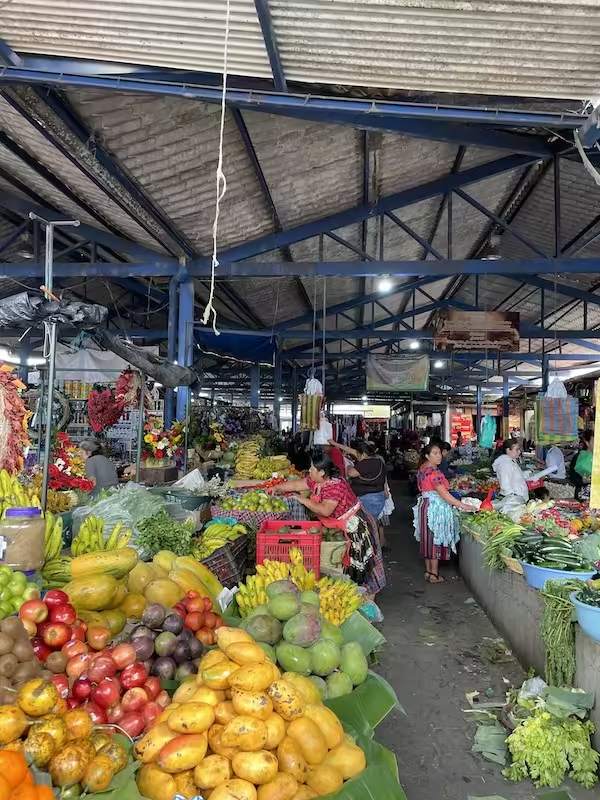
Travel Safety vs. Tourist Crime
I’ve focused a lot on murder so far. That’s because I get frustrated sometimes with the “safety” posts on other blogs and travel guides. They’ll talk about getting murdered and having something stolen or being scammed in the same breath. As if losing your phone is nearly as big of a deal as losing your life. And yet, they’ll overlook real dangers like drownings and traffic accidents.
I think we need to reframe how we think of safety. Not all crime is a safety issue. You can survive theft, and if you have travel insurance, it’s really more of an inconvenience than anything else.
Robberies and theft do happen. It’s never happened to me personally, but I’ve met other travelers who’ve had bags stolen, and one woman who was mugged by a kid with a machete. However, these things are also rare.
Unfortunately, I don’t have enough numbers to really back that up. The U.S. State Department doesn’t track them, and few local police forces publish detailed reports.
Thankfully, Costa Rica has some data we can use as an example. Out of the multiple millions of international tourists in 2024, only 500 reported robberies or thefts. Even considering that number is probably low, it’s still a very, very, small amount considering how many people visit Costa Rica. The odds are 1 in 5,207
Even considering that many thefts go unreported, those are still pretty good odds.
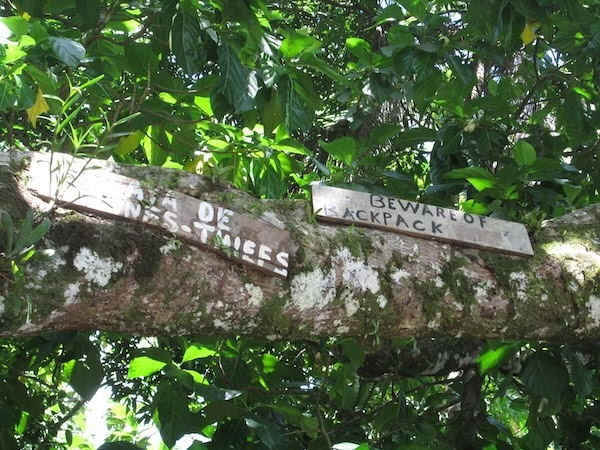
Avoiding Tourist Crime in Central America
Go to remote areas in groups: Certain hiking trails and isolated beaches may seem beautiful, but they can be targets for muggers or thieves. You can always ask a local if a certain trail or beach is safe. Even if it’s not, you’re usually going to be fine if you go with other people.
Keep an eye on your belongings / don’t flash valuables in public: According to the Costa Rican Judicial Investigation Agency, of all the robberies and thefts in the country “82% [of thefts were] targeting items like phones or laptops left visible.” Those are crimes of opportunity. Keep an eye on your belongings. Only carry what you need for the day and leave your passport and cards in your hotel or a hostel safe.
Use a money belt and a belt bag: A money belt goes under your clothes and is a great way to store your passport, cards and cash. It’s especially useful on buses. A belt bag, or fanny pack, or bum bag, is great for keeping your phone and wallet zipped up while you’re out and about.
Don’t bring anything you don’t mind losing: This is probably the best travel advice I ever got. Not only is it good advice in case of theft, but also in case you forget your bag or accidentally drop it in a volcano. In the end, they’re just things, and things are replaceable.
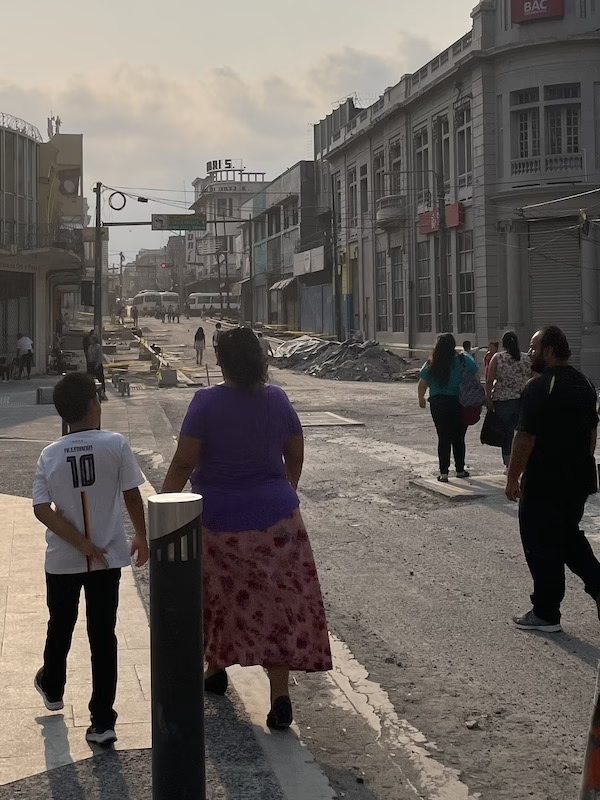
Other Potential Travel Dangers to Look Out for in Central America
We covered a lot of the things that could kill you. We also talked about robberies and theft, which won’t kill you but still aren’t good. Now, let’s discuss a few of the safety issues in Central America that also probably won’t kill you, but could potentially ruin your trip.
Dogs and animal bites: We met numerous people who’d been bit by street dogs. Central America’s street dogs might look cute, but they aren’t to be messed with. Read up on how to deal with aggressive dogs, just in case.
Aside from dogs, Central America has other dangerous animals. The rule of thumb is to always admire wild animals from a distance. Never approach them, and definitely, never, ever, ever feed a wild animal.
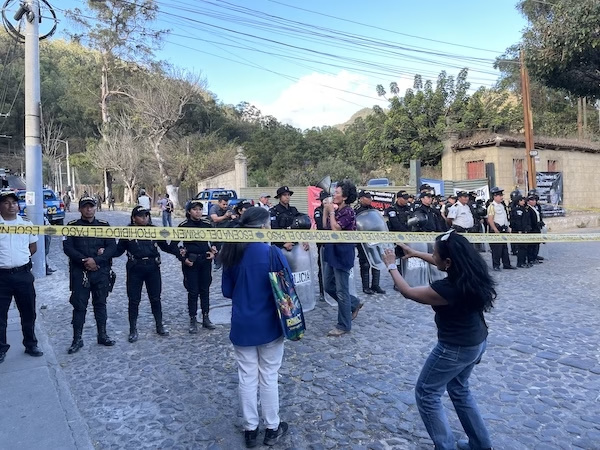
Protests and civil unrest: Central America sees its fair share of protests and strikes. Understandable in a region notorious for corrupt political regimes. Protests range from a handful of people holding signs and chanting to massive street marches to full on riots with blockades and Molotov cocktails.
The standard advice is to avoid all protests. I will counter that we actually came across a couple of protesters who were more than happy to explain what they were protesting to some curious tourists. Use your best judgement and try and gauge the mood. If in doubt, stay away.
You may find that protesters have blockaded the road you need to go on, or even surrounded the airport. There’s not much you can do in these situations. Just be patient, and recognize that they are probably out there for a good reason. They’re frustrated with the system, not trying to personally ruin your vacation.
Storms, earthquakes and volcanic eruptions: Central America’s Caribbean coastline often puts the region in the path of some ferocious hurricanes. And hurricanes tend to be getting worse with climate change. Try to avoid traveling to Belize, Honduras, Guatemala and Nicaragua during hurricane season, usually August to October.
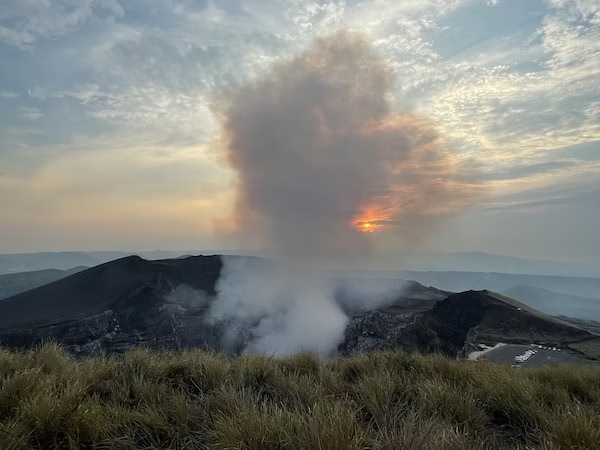
All of Central America lies on the boundaries of five tectonic plates. Earthquakes and volcanic eruptions are common. Usually, they aren’t a huge deal, but they have the potential to be destructive. There isn’t much you can do to avoid an earthquake or volcanic eruption. Just pay attention to any local warnings and follow the directives of authorities.
A Quick Plug for Travel Insurance
As you’ve probably gathered by now, Central America is mostly quite safe. But things can and do happen. That’s where good travel insurance comes in.
I used to never buy travel insurance when I was younger. It felt like I was throwing away money on something that may or may not happen.
Now that I’m older, and some would say wiser, I’m more in favor of insurance. Decent travel insurance can turn a potential trip-ruining disaster into a mere inconvenience.
We used World Nomads during our Central America trip. It was inexpensive and easy to use. They cover a lot of potential scenarios and activities, too. Luckily, we didn’t need to use it.
You could also give SafetyWing a try. They used to be more geared to expats and longer-term travelers, but have recently rolled out a program for shorter trips. SafetyWing is especially nice if you don’t quite know the end date of your trip, since you can renew monthly. We’ve also used them, and have zero complaints.
* We receive a fee when you get a quote from World Nomads using this link. We do not represent World Nomads. This is not a recommendation to buy travel insurance. The same applies to SafetyWing.
Our Personal Experience of Travel Safety in Central America
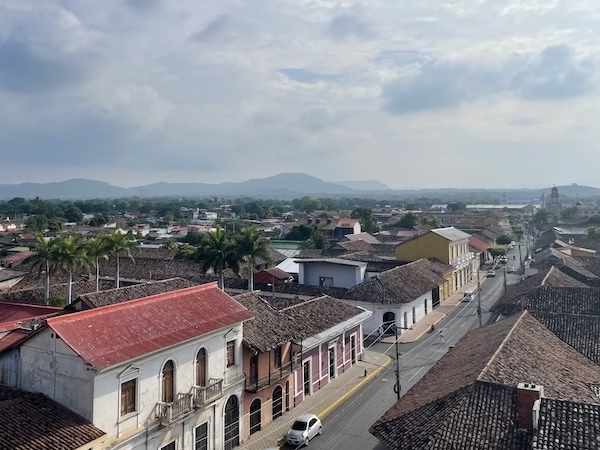
I’ve traveled to Central America numerous times over the years. Most recently, my wife and I spent nearly six months in the region, traveling from Guatemala to Panama, mostly by local bus. In all that time, I never once felt unsafe. At least, in terms of crime.
I’ve never been mugged, and never even had anything stolen. I have found that the vast majority of Central Americans are friendly, honest people. More often than not, I’ve had locals offer advice on staying safe and even sometimes personally guided me away from a potentially dangerous neighborhood back to a safe area.
In fact, I overwhelmingly felt like the local people were really looking out for me. They want tourists to have a fun, safe time in their countries.
I have had a few run-ins with stray dogs, and luckily escaped unscathed. I faced a sudden ocean storm in Drake Bay, Costa Rica and high waves that rocked our boat in Livingston, Guatemala. We were also accosted on two separate occasions by aggressive monkeys in Costa Rica. And, of course, the insane traffic.
I’ll be honest, the storm and waves were really the only situations where I actually felt afraid for my life. I will always wear a life jacket after those experiences. The rest just felt like part of the adventure. Central America is a much better place for an adventure than a vacation.
I truly believe that Central America is a perfectly safe destination for tourists. The dangers that do exist there could happen anywhere. And in researching for this post, I was happy to discover that the data seems to back up my beliefs.
The Most Important Travel Safety Advice for Central America: Don’t Be Afraid
I didn’t always have as much faith in Central America’s safety as I do today. Before our six-month backpacking trip, countless friends and family members back home constantly warned us about the dangers of traveling to Central America. Some literally begged us not to go.
I hate to admit it, but their fear managed to somehow worm its way into my subconscious. I couldn’t help looking at the locals suspiciously. Was that campesino on the hiking trail going to attack me with his machete? Was the woman standing behind me in the line for the bus trying to pickpocket me?
Okay, maybe I wasn’t that extreme, but I definitely had a sense of paranoia and suspicion that was hard to shake. It made the trip less fun, that’s for sure. Only after weeks of having those preconceptions shattered by the warmth and friendliness of the local people did that sense of paranoia and suspicion begin to melt away.
I remember wandering around the streets of Quetzaltenango in Guatemala. A blue convertible pulled up to an intersection. I think it might have been a Cadillac. The driver was a Guatemalan with a shaved head wearing a white tank-top. His body and face were black and blue with tattoos.
“Oh shit!” I thought to myself, “this guy is probably a real-life gang member.”
I froze. I was probably staring at him, inadvertently. That probably wasn’t a good idea, but I couldn’t really help it. He turned his head and we made eye contact.
He flashed me the biggest, toothiest grin. Then he reached up and gave me a friendly wave. I returned a befuddled smile back and waved as he drove away.
If you take one thing from this blog post it’s this: don’t be afraid of Central America. Central America is perfectly safe for tourists. Don’t let other people’s fear and paranoia ruin your trip.
Sources for Data Used in this Post
Here are all my sources for U.S. visitor data, and once again, the link to the U.S. State Department’s list of overseas deaths. Feel free to check my math yourself. I hope this data can alleviate any concerns you might have. I also hope you can use some of these statistics to alleviate the safety concerns of any friends and family who might be worried about you traveling to Central America.
55 total U.S. citizen deaths in Central America in 2023. 5 homicides. https://travel.state.gov/en/international-travel/living-abroad/death.html#accordion-4528c1030b-item-6a05b7532d
Belize: 317,000 U.S. tourists. https://www.belizeadventure.ca/who-visits-belize/
Costa Rica: 1,431,644 U.S. tourists. https://en.travel2latam.com/news-87493-clia-opens-registrations-for-the-first-edition-of-cruise360-brazil.html
El Salvador: 1,330,000 U.S. tourists. https://investinelsalvador.gob.sv/foreign-visitation-to-el-salvador-increased-by-17-in-2024/
Guatemala: 394,258 U.S. tourists. https://travelisimo.com/news/tourism-guatemala-increase-iguat-travel-flights-central-america
Honduras: 440,062 U.S. tourists. (overnight stays, not cruise ship passengers) https://tourismanalytics.com/honduras-statistics.html
Panama: 401,085 U.S. tourists. https://www.atp.gob.pa/wp-content/uploads/2024/04/Informe-Estadistico-Enero-a-Diciembre-2023.pdf
Here is the article with data about theft and robberies in Costa Rica: https://ticotimes.net/2025/04/19/costa-rica-grapples-with-rising-crime-san-jose-robberies-surge
Planning a longer trip? Check out our complete guide to backpacking Central America from Guatemala to Panama.
Useful Websites for Traveling Central America
As much as we might long for the days when you could show up to a town with nothing more than a beat-up guidebook and a sense of adventure, today much of traveling involves being glued to our phones making bookings. I’ve compiled some helpful apps and websites below that at least help make those bookings more convenient so you can spend less time staring at your phone and more time exploring at your surroundings. Some of these sites are affiliate links that give me a small commission at no cost to you if you chose to book through them. All of them are sites I’ve used personally and have no problem recommending.
Just be sure to do your due diligence as much as possible. Only hire local guides and try as much as possible to stay in locally owned hotels and hostels so that your hard earned travel dollars actually go to support the local economies of the places you visit.
Booking.com is basically the world’s only hotel booking website. They have hotels, guesthouses and vacation rentals all over Central America.
Hostelworld is the go-to site for booking hostels. If dorm rooms and shared bathrooms are your thing, you’ll find hostels all over Central America.
Get Your Guide offers tours and activities all around the world. Unlike some other sites and apps that do the same thing, you can actually find some reasonably priced deals here.
Centro Coasting is a great website to look up bus routes and times throughout Central America. Schedules change regularly, and the site is sometimes not as up to date as you’d like. However, it’s a good resource to help give you an idea when the buses leave, or at least get you to the right terminal.
Travel insurance can turn a potential trip-ruining disaster into a mere inconvenience. We used World Nomads for travel insurance during our Central America trip. I found them easy to use and set up. We’ve also used SafetyWing and had a good experience. If you do decide to get travel insurance, I suggest comparing both options and seeing what works for you.
We receive a fee when you get a quote from World Nomads using this link. We do not represent World Nomads. This is not a recommendation to buy travel insurance. The same applies to SafetyWing.